


You can have a beautiful logo and a broken brand. Here’s why and what to do about it.
Every week, a founder somewhere commissions a logo and calls it branding. They spend weeks on typefaces and colour palettes. They launch, wait for the world to notice, and wonder why nothing changed.
This is one of the most common and costly misunderstandings in business. The logo is not the brand. It never was. And building on that misunderstanding will cost you more than the original design brief.
So what is a brand, exactly? And why does getting the answer right matter so much?
A Logo Is a Symbol. A Brand Is a Feeling.
Your logo is a mark; a visual shorthand that helps people recognise you. It is necessary, and it matters. But it is the surface, not the substance.
Think about the brands you have a genuine relationship with. The ones you return to, recommend, defend. What makes you loyal to them is almost certainly not their logo. It is how they make you feel. The consistency of the experience. The sense that they understand you. The trust that has built up over time.
That is a brand. And it lives in a very different place than your design files.
You can change a logo overnight. You cannot change a brand overnight. One is a file. The other is a relationship.
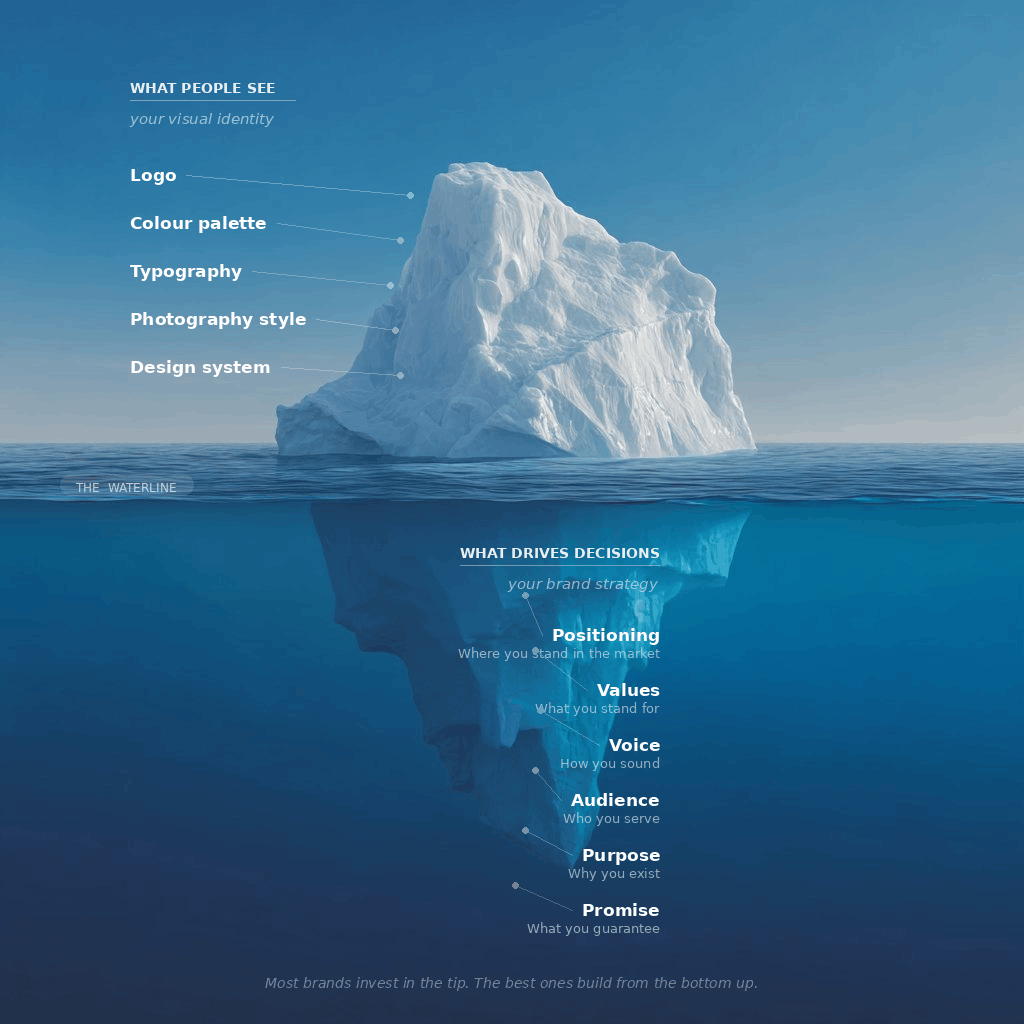
The Iceberg Most Founders Never See
A useful way to think about brand identity is as an iceberg.
Above the waterline, the part everyone can see, is your visual identity: logo, colour palette, typography, photography style, design system. This is what most founders invest in when they say they are ‘doing their branding’.
Below the waterline, invisible to the casual observer but responsible for everything above staying afloat, is your brand strategy: your positioning, your values, your voice, your audience, your purpose, your promise. This is where a brand is actually built.
When founders skip the strategy and go straight to the logo, they are building the tip of the iceberg with no ice beneath it. It looks right for a moment. Then it melts.
- Positioning: where you sit in the market and why that matters
- Voice: how you sound across every touchpoint — website, email, social, conversation
- Values: what you will and won’t do, and why clients trust you because of it
- Audience clarity: who specifically you are for and who you are not for
- Promise: what changes for a client because they worked with you

When the Logo Isn’t the Problem
This is where it gets counterintuitive. Sometimes a brand that isn’t working gets a new logo. The new logo looks great. Nothing changes. And the founder concludes that branding doesn’t work.
But the logo was never the problem. The problem was the strategy underneath it. Or the lack of one.
A new logo applied to an unclear positioning is still an unclear positioning, just with better typography. You cannot design your way out of a strategic problem.
The inverse is also true: a brand with genuine strategic clarity can survive an imperfect logo. The coherence of the experience carries it. The logo becomes almost secondary.
You cannot design your way out of a strategic problem. A new logo applied to an unclear positioning is still an unclear positioning, just with better typography.
What to Do Before You Hire a Designer
None of this means your logo doesn’t matter. It does. A well-designed visual identity, built on solid strategy, is one of the most powerful assets your brand can have.
But the sequence matters. Before you commission a designer, you need answers to a set of strategic questions:
- Who exactly is this brand for and what do they want to feel when they encounter it?
- What is the one thing this brand stands for that no competitor can own?
- What is the brand’s voice and is it consistent everywhere your client meets you?
- What experience does a client have from first discovery to final delivery and is every touchpoint intentional?
Get those answers right and you will brief your designer with the kind of clarity that produces work you won’t want to change in two years. Skip them and you’ll be back at the logo brief sooner than you think.
The Real Definition of Brand
Jeff Bezos once said that your brand is what people say about you when you’re not in the room. That is as good a definition as any.
It is the sum of every interaction someone has ever had with your business. Every email. Every social post. Every client call. Every invoice. Every moment of delight or disappointment.
A logo cannot control any of that. Only a brand, built deliberately, from strategy outward, can.